Need Immediate Electrical Assistance in Independence?
Our experienced technicians are dispatched across Independence and surrounding Jackson County neighborhoods. Speak directly with our local dispatch desk for prompt troubleshooting coordination, safety inspections, and clear project estimates.
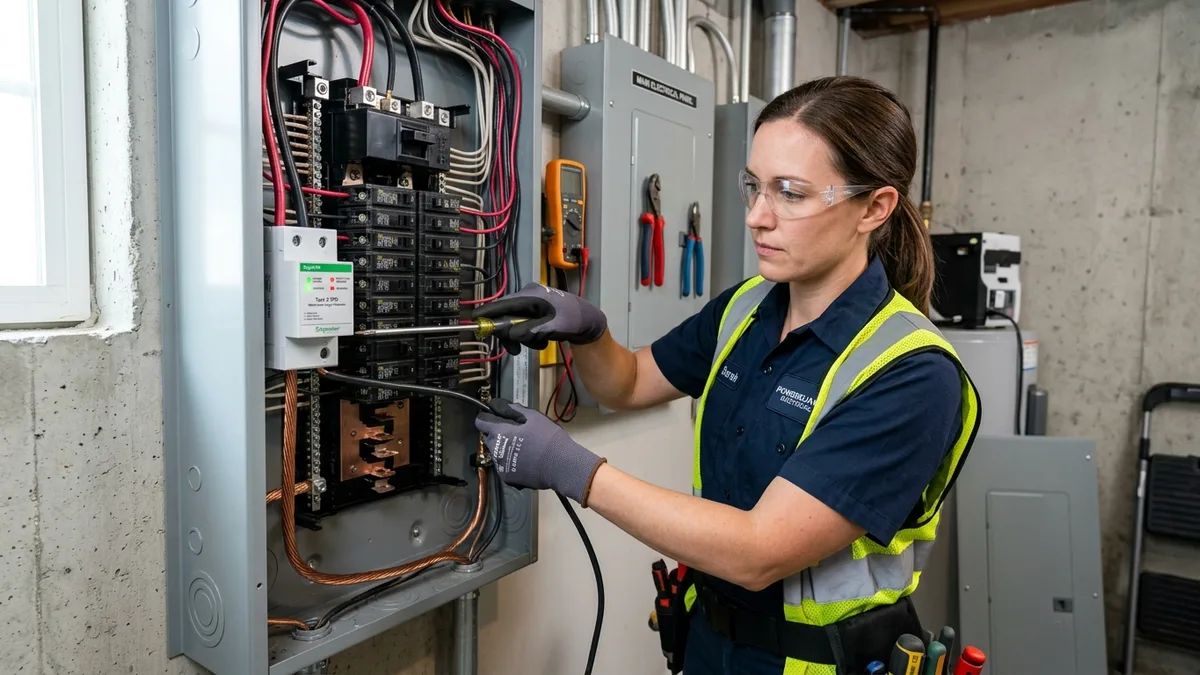
Comprehensive Whole-Home Surge Protection Engineering in Independence, Missouri
Modern residential households throughout Independence, Missouri are packed with delicate, microprocessor-driven technology. From inverter-driven heat pumps, smart refrigerators, and induction cooktops to home theater computers, security systems, and Level 2 electric vehicle charging stations, today’s properties contain tens of thousands of dollars in sensitive solid-state electronics. Unlike vintage electro-mechanical appliances that could absorb minor voltage variations without damage, modern microchips operate on tiny 3.3-volt and 5-volt direct-current thresholds. An electrical transient lasting mere microseconds can degrade microscopic silicon pathways, causing premature component failure, random system lockups, or catastrophic destruction.
At Electrician Independence, our specialized electrical services network delivers engineered whole-home surge protection solutions designed to shield your entire property from destructive electrical transients. Installed directly at your main electrical service panel or meter base, a heavy-duty Surge Protective Device (SPD) intercepts high-voltage transients from lightning strikes, utility grid switching, and internal inductive motor cycles, safely shunting excess energy directly to earth before it can enter your interior branch circuits.
Every installation coordinated through our network satisfies the latest National Electrical Code (NEC Article 230.67) mandates requiring surge protection on all newly installed or upgraded residential services, and coordinates seamlessly with Independence Power and Light (IPL) and Evergy utility interfaces across Jackson County.
The Two Sources of Electrical Surges: External vs. Internal Transients
Most property owners associate electrical surges exclusively with violent lightning storms. However, electrical forensic engineering studies demonstrate that surges originate from two distinct sources, both of which require robust transient voltage suppression:
1. External Grid Surges (High-Energy, Low-Frequency Events)
External surges enter your home through overhead service drops, underground power laterals, or telephone and cable lines. Common causes include:
- Cloud-to-Ground Lightning Strikes: A lightning strike near a utility pole or overhead distribution line can inject tens of thousands of volts into local power lines, creating massive voltage wavefronts that surge into neighborhood homes.
- Utility Grid Switching and Capacitor Bank Cycling: When municipal utilities like Independence Power and Light switch high-voltage distribution lines or engage large capacitor banks to correct power factor, transient inductive voltage spikes ripple across residential feeds.
- Downed Power Lines and Storm Accidents: Severe windstorms or vehicle collisions with utility poles can cause high-voltage distribution conductors to contact lower-voltage residential lines.
2. Internal Micro-Surges (Low-Energy, High-Frequency Daily Events)
Approximately 70% to 80% of all electrical transients originate inside your own home. Every time heavy inductive motor loads—such as central air conditioning compressors, refrigerator pumps, vacuum cleaners, power tools, or garbage disposals—cycle on and shut off, the collapsing magnetic field inside the motor windings generates an inductive kickback spike of 300 to 1,200 volts. While a single internal micro-surge rarely causes immediate appliance destruction, the cumulative effect of dozens of daily micro-spikes degrades microprocessors over time—a phenomenon known in the trade as “electronic rust.”
Technical Comparison: The Three Classes of Surge Protective Devices (SPDs)
Complete transient protection requires a layered, cascading defense strategy. Under National Electrical Code Article 242 and UL 1449 standards, surge protective devices are categorized into three distinct classifications:
| SPD Classification | Installation Location | Primary Operational Function | Surge Current Rating (kA) | Ideal Protection Scope |
|---|---|---|---|---|
| Type 1 SPD | Line-Side of Main Disconnect (Meter Base) | Intercepts massive external lightning surges and utility grid transients | 50 kA to 100+ kA per phase | External grid entrance defense |
| Type 2 SPD | Load-Side of Main Disconnect (Main Panel) | Protects interior branch circuits, subpanels, and hardwired equipment | 40 kA to 80 kA per phase | Whole-home panel distribution |
| Type 3 SPD | Point-of-Use Wall Plug (Power Strips) | Clamps residual micro-transients at individual sensitive devices | 10 kA to 20 kA | Computers, audio/video gear |
Relying solely on inexpensive plastic Type 3 power strips from big-box stores leaves your home’s most expensive appliances—central air conditioning compressors, water heaters, dishwashers, and EV charger installations—completely unprotected, as hardwired 240-volt equipment cannot be plugged into a standard power strip. A panel-mounted Type 1 or Type 2 SPD provides comprehensive protection for every circuit in your home simultaneously.
How Metal Oxide Varistor (MOV) Technology Protects Your Property
Modern whole-home surge protective devices utilize high-capacity Metal Oxide Varistor (MOV) arrays combined with thermal disconnect fuses:
Variable Electrical Resistance
Under normal 120/240-volt sinusoidal alternating current, an MOV maintains extremely high electrical resistance (effectively acting as an open switch), allowing standard power to flow uninterrupted into your home’s branch circuits.
Nanosecond Clamping Activation
When a transient voltage spike exceeding the device’s Maximum Continuous Operating Voltage (MCOV)—typically 150 volts on a 120V line—strikes the panel, the MOV’s internal semiconductor structure shifts from high resistance to near-zero resistance in less than one nanosecond.
Safe Energy Dissipation to Earth
The MOV instantly creates a low-impedance diversion pathway, directing thousands of amps of surge current safely into the home’s grounding electrode system (ground rods and water pipe bonding) and neutral conductor. Once the transient voltage dissipates, the MOV automatically resets to its high-resistance state, ready for the next event.
Thermal Runaway Protection
In the event of a catastrophic direct lightning strike that exceeds the physical energy absorption capacity of the MOV, internal thermal fuses permanently disconnect the failed varistor element, preventing internal short circuits or fires within the surge protector body while illuminating an external diagnostic LED indicator to signal that replacement is required.
National Electrical Code (NEC Article 230.67) Mandate
Recognizing the vulnerability of modern household electronics, the National Electrical Code introduced Article 230.67, making surge protection mandatory for residential properties:
- Mandatory on All Residential Services: All new single-family and two-family residential electrical service panels must be equipped with an approved Type 1 or Type 2 Surge Protective Device (SPD).
- Mandatory on Panel Upgrades and Replacements: When homeowners replace an obsolete 100-amp electrical panel or modernize to 200-amp service, a code-compliant SPD must be installed as part of the permitted project scope.
- Integral or Adjacent Mounting: The SPD must be an integral component of the service equipment or mounted immediately adjacent to the main panel enclosure connected with minimal conductor lead lengths to optimize clamping performance.
If you are planning an electrical panel upgrade in Independence MO, our technicians incorporate a commercial-grade Type 2 SPD directly into your permitted project proposal.
The Surge Protection Installation and Commissioning Process
Installing a whole-home surge protective device requires specialized trade execution to minimize lead-wire impedance:
Phase 1: Grounding Electrode System Verification
A surge protector can only divert electrical transients as effectively as your grounding system can dissipate energy into the earth. Before mounting an SPD, our technicians test your property’s grounding electrode system, verifying that dual eight-foot copper-clad ground rods are spaced at least six feet apart and bonded to your incoming metallic water piping with continuous bare copper wire.
Phase 2: Panel Placement and Dedicated Breaker Installation
The SPD is mounted directly to the main service panel enclosure using rigid nipple fittings. We install a dedicated two-pole 20-amp or 30-amp circuit breaker located in the highest available slots directly adjacent to the main incoming service lugs. Placing the breaker at the top of the bus bars ensures the shortest possible conductor pathway, reducing inductive lead-wire resistance and improving transient response times.
Phase 3: Ultra-Short Conductor Routing
Every inch of conductor wire between the breaker and the surge protector adds approximately 15 to 25 volts of inductive overshoot during a fast-rising lightning transient. Technicians route hot, neutral, and ground conductors with minimal lengths, avoiding sharp 90-degree bends to maximize clamping efficiency.
Phase 4: Torque Verification and Diagnostic Commissioning
All breaker terminal screws and neutral/ground lugs are torqued using calibrated torque screwdrivers in compliance with NEC 110.14(D). Technicians power on the unit, verify that green diagnostic status LED indicators illuminate across all phases, and test the audible alarm module.
Review our transparent electrician cost guide in Independence MO to explore typical installation costs for panel-mounted surge protective devices.
Pairing Surge Defense With Generators and Solar Systems
Whole-home surge protection is a vital complementary defense for other advanced energy investments across Jackson County:
- Standby Generator Defense: Utility line reconnects and automatic transfer switch cycling frequently generate transient inductive switching spikes. Installing an SPD protects the sensitive control microprocessors inside both your generator and transfer switch. Explore our generator installation services.
- Electric Vehicle Charger Protection: Safeguarding high-amperage dedicated 240V circuits and the delicate onboard electronic inverters within your electric vehicle. Explore our EV charger installation solutions.
- Historic Home Wiring Preservation: Older homes throughout the Truman Heritage District that have undergone phased house rewiring benefit immensely from surge protection, preventing voltage spikes from stressing vintage branch circuits.
Schedule Your Whole-Home Surge Protection Installation Today
Do not leave your home’s expensive smart appliances, HVAC compressors, computers, and electronics vulnerable to the next severe Jackson County thunderstorm. Invest in engineered whole-home surge defense with Electrician Independence.
Contact our local dispatch desk today at (816) 586-5537 to schedule an on-site installation, or submit an inquiry through our secure online contact form. Our experienced professionals will evaluate your service panel, explain your protection options, and provide a clear written estimate for your review.
Transparent Pricing and Diagnostic Disclosure
Project costs, diagnostic fees, and installation rates displayed or discussed are regional market estimates for Independence, MO and surrounding Jackson County jurisdictions. Actual pricing varies based on exact on-site conditions, code compliance requirements, electrical panel capacity, materials needed, and municipal permit parameters enforced by the City of Independence Building Inspection Division or Independence Power and Light (IPL).
Estimates are for budgeting purposes only. Actual prices vary based on on-site conditions. Every service inquiry receives an on-site physical evaluation and a clear written estimate before any physical work begins.