Need Immediate Electrical Assistance in Independence?
Our experienced technicians are dispatched across Independence and surrounding Jackson County neighborhoods. Speak directly with our local dispatch desk for prompt troubleshooting coordination, safety inspections, and clear project estimates.
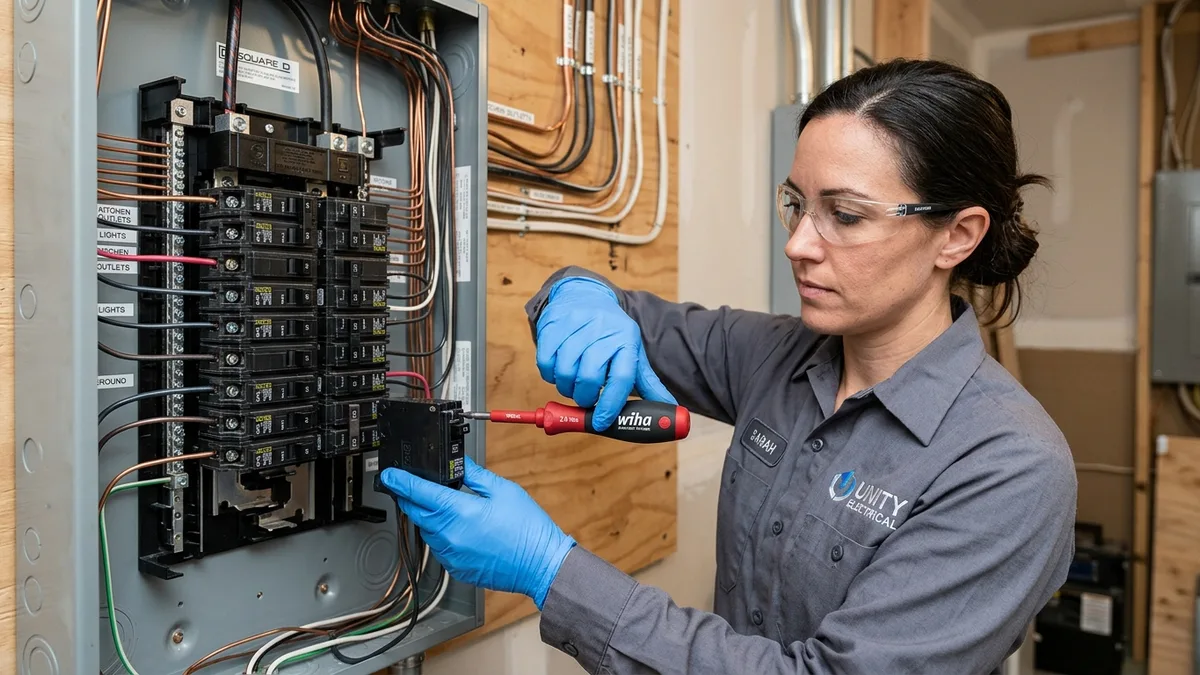
Precision Circuit Breaker Diagnostics and Replacement in Independence, Missouri
Inside your electrical panel, circuit breakers serve as the frontline defense against electrical fires, conductor overheating, and equipment destruction. When an electrical circuit experiences an excessive current draw or a sudden dead short, the circuit breaker is calibrated to trip within milliseconds, cutting off electrical current before the in-wall copper conductors can reach the flashpoint of structural framing materials. However, circuit breakers are mechanical devices containing sensitive internal bimetallic strips, calibrated electromagnetic coils, springs, and arc chutes. Over decades of operation, continuous thermal cycles, electrical arcing, and atmospheric humidity cause internal components to fatigue, corrode, or fail entirely.
At Electrician Independence, our specialized electrical services network delivers prompt, empirical circuit breaker diagnostics and code-compliant replacements throughout Independence, Blue Springs, Lee’s Summit, and Raytown. Rather than merely resetting a tripped breaker repeatedly—a hazardous practice that can ignite an electrical fire—our experienced technicians identify whether the failure originates from an appliance overload, a short circuit in the branch wiring, or internal breaker fatigue. If your main panel contains damaged bus stabs or obsolete hardware, we evaluate whether component replacement or a complete electrical panel upgrade in Independence MO represents the safest path forward.
Anatomy of a Circuit Breaker: How Overcurrent Protection Functions
Understanding how a modern circuit breaker operates clarifies why professional evaluation is vital when a breaker malfunctions. A standard thermal-magnetic circuit breaker incorporates two independent tripping mechanisms:
1. Thermal Trip Mechanism (Overload Defense)
The thermal mechanism protects branch wiring from sustained, low-level overcurrent conditions (such as running a space heater, microwave, and vacuum cleaner simultaneously on a 15-amp circuit). Current passes through an internal bimetallic strip composed of two bonded metals with differing thermal expansion rates. As excessive current flows, heat builds, causing the bimetallic strip to bend. When the strip deflects to a calibrated point, it releases the mechanical trip latch, opening the internal contacts and cutting off power. The thermal response is inverse-time: a mild overload takes several minutes to trip, while a heavy overload trips within seconds.
2. Magnetic Trip Mechanism (Short Circuit Defense)
The magnetic mechanism protects against catastrophic high-amperage short circuits (such as a metal nail puncturing both hot and neutral wires inside a wall, or an appliance motor winding shorting out). When hundreds or thousands of amps surge through the breaker, current energizes an internal electromagnetic solenoid, instantly pulling the armature to release the trip latch in less than one-sixtieth of a second (one single AC cycle). An internal arc chute absorbs and cools the resulting high-energy plasma arc, extinguishing it safely inside the breaker body.
Critical Warning Signs of Circuit Breaker Failure
Circuit breakers rarely fail without exhibiting physical symptoms. If you observe any of the following conditions in your electrical panel, do not attempt to force the breaker handle into the on position. Contact our dispatch desk for professional evaluation:
1. The Circuit Breaker Trips Immediately Upon Resetting
If you push a tripped breaker firmly to the “off” position to reset the internal spring mechanism, push it to the “on” position, and it trips instantaneously with an audible snap or flash, the circuit has an active short circuit or a seized motor compressor. Attempting to force the breaker handle on can cause the breaker to explode in an arc flash event. Review our troubleshooting guide on why your circuit breaker keeps tripping.
2. Audible Humming, Buzzing, or Sizzling Sounds
A properly functioning circuit breaker operates with complete silence. If you hear a distinct low-frequency hum, buzzing vibration, or sizzling noise coming from an individual breaker or the panel interior, micro-arcing is occurring. This typically indicates a loose mechanical termination screw or worn female bus stabs that have lost spring tension against the panel’s energized copper bus bar. Review our safety guide on buzzing electrical panels.
3. Breaker Handle Feels Loose, Spongy, or Fails to Latch
If flipping the breaker handle feels spongy, has no distinct mechanical click, or refuses to stay in the “on” position even when the branch circuit is completely disconnected, the internal mechanical trip springs have lost tension or burned out. A breaker with a broken mechanical latch cannot provide overcurrent protection and must be replaced immediately.
4. Scorching, Melting, or Burning Odors Near the Panel
Any discoloration on the breaker casing, brown heat marks on the plastic deadfront, or a fishy, acrid odor signifies that terminal resistance has generated temperatures exceeding 300 to 400 degrees Fahrenheit. The wire insulation and breaker casing are actively decomposing. Review our protocol for electrical burning smells in the house.
5. Arc-Fault (AFCI) or Ground-Fault (GFCI) Diagnostic Code Trips
Modern Dual-Function AFCI/GFCI breakers feature diagnostic LED indicator lights that flash specific sequences when tripped. These flash codes indicate whether the trip resulted from a parallel arc, a series arc, a ground fault, or high-voltage line surges. Our technicians decode these LED flash sequences using manufacturer diagnostic charts to isolate in-wall faults rapidly.
Technical Comparison: Circuit Breaker Technologies
The table below contrasts standard thermal-magnetic breakers with modern electronic safety breakers and hazardous legacy hardware:
| Breaker Classification | Internal Operating Technology | Primary Safety Protection | Replacement Cost Level | Insurance Acceptability |
|---|---|---|---|---|
| Standard Thermal-Magnetic | Bimetallic strip and electromagnetic coil | Overloads and dead short circuits | Standard | Accepted across all carriers |
| Ground-Fault (GFCI) | Current differential sensing coil (4-6 mA) | Lethal electric shock in wet areas | Moderate | Mandatory in kitchens/baths |
| Arc-Fault (AFCI) | Digital microprocessor and waveform sensing | In-wall electrical fires from arcing | Moderate to High | Mandatory on living area circuits |
| Dual-Function (AFCI/GFCI) | Combined microprocessor and differential coil | Complete shock and fire protection | High | Current code standard |
| Federal Pacific Stab-Lok | Defective mechanical latch and weak spring | High failure rate (fails to trip) | Obsolete (Full Panel Upgrade) | Widely denied coverage |
| Zinsco / Sylvania | Aluminum bus clips prone to corrosion | Breakers fuse to bus bar | Obsolete (Full Panel Upgrade) | Widely denied coverage |
Why Exact OEM Brand Matching and Torque Standards Matter
Replacing a circuit breaker is not a generic, universal task. Every manufacturer designs breaker bodies, clip tensions, and bus stab geometries to proprietary tolerances:
Strict Prohibition on “Cheater” or Alien Breakers
Homeowners and informal handymen frequently install whatever brand of breaker happens to fit mechanically into a panel slot (e.g., forcing a Square D Homeline breaker into a Siemens or Eaton panel). While the breaker may appear to snap into place, microscopic dimensional differences between the female breaker clip and the male bus stab create uneven contact pressure. Under heavy electrical load, this loose contact creates intense resistance heating, melting the bus bar and rendering the entire panel unusable. Our technicians install exclusively UL-listed, manufacturer-specified OEM replacement breakers (or classified replacement breakers formally certified for the specific panel model).
Calibrated Torque Standards (NEC 110.14(D))
Loose terminal screws are one of the leading causes of electrical fires in residential distribution panels. Since the adoption of National Electrical Code Article 110.14(D), all mechanical wire terminations must be tightened using calibrated torque screwdrivers and torque wrenches to the manufacturer’s exact inch-pound specifications (typically 20 to 45 in-lbs depending on wire gauge and lug design). Our technicians never guess at tightness; every conductor is torqued using calibrated instruments to eliminate hot spots.
Addressing Obsolete Breakers: Federal Pacific and Zinsco Hazards
In older Independence neighborhoods—including mid-century homes throughout Fairmount, Rockwood, and the Truman Heritage corridor—technicians frequently encounter panels manufactured by Federal Pacific Electric (FPE) and Zinsco:
- Federal Pacific Electric (FPE) Stab-Lok Breakers: Independent scientific testing conducted by the Consumer Product Safety Commission (CPSC) and electrical forensic engineers revealed that FPE Stab-Lok breakers fail to trip under overcurrent conditions in up to 25% of cases. Under sustained overload, the internal mechanism jams, allowing wires inside walls to reach red-hot temperatures while the breaker remains engaged.
- Zinsco and GTE-Sylvania Breakers: Zinsco breakers utilize an aluminum bus clip that makes contact with an unplated aluminum bus bar. Over time, electrolytic corrosion between the clip and bus bar creates high resistance. The resulting heat melts the plastic breaker housing, fusing the breaker directly onto the bus bar. Once fused, the breaker can never be removed or safely tripped.
When our technicians identify FPE or Zinsco equipment, we advise against attempting individual breaker replacements, as replacement breakers available online are often refurbished or counterfeit units that carry identical failure rates. Instead, we outline a comprehensive, permanent electrical panel upgrade that replaces the entire assembly with a modern 200A load center.
Diagnostic and Repair Workflow for Malfunctioning Breakers
When you contact Electrician Independence for circuit breaker repair, our technicians follow an established four-step diagnostic and replacement process:
- Deadfront Removal and Visual Inspection: Dispatched technicians wear protective eye and face protection, remove the panel deadfront, and visually inspect bus bars for pitting, thermal discoloration, or insulation breakdown.
- Current and Load Measurement: Using True-RMS clamp-on ammeters, technicians measure the exact continuous current draw on the affected circuit to determine whether an appliance overload exists.
- Branch Circuit Resistance Testing: The branch circuit is disconnected from the breaker and tested with an insulation resistance tester (megohmmeter) to confirm that the in-wall conductors have not suffered dielectric breakdown.
- OEM Breaker Installation and Torquing: A factory-certified OEM replacement breaker is snapped into an undamaged bus stab slot. Conductor wire is stripped to exact gauge length and torqued to manufacturer specifications using a calibrated torque screwdriver.
- Circuit Labeling and Functional Verification: The technician performs continuity verification, verifies proper trip functionality, and updates the panel directory schedule for clear identification.
To review pricing parameters for individual breaker replacements and panel service calls, consult our electrician cost guide in Independence MO.
Schedule Your Circuit Breaker Inspection and Repair Today
Do not ignore a circuit breaker that hums, repeatedly trips, or feels warm to the touch. These symptoms represent your electrical system’s warning signs of impending thermal failure.
Contact Electrician Independence today at (816) 586-5537 to schedule an on-site circuit breaker diagnostic evaluation with an experienced field technician, or submit your project details through our secure online contact portal. Our team will evaluate your panel, provide an itemized written estimate, and restore safe, reliable overcurrent protection to your home.
Transparent Pricing and Diagnostic Disclosure
Project costs, diagnostic fees, and installation rates displayed or discussed are regional market estimates for Independence, MO and surrounding Jackson County jurisdictions. Actual pricing varies based on exact on-site conditions, code compliance requirements, electrical panel capacity, materials needed, and municipal permit parameters enforced by the City of Independence Building Inspection Division or Independence Power and Light (IPL).
Estimates are for budgeting purposes only. Actual prices vary based on on-site conditions. Every service inquiry receives an on-site physical evaluation and a clear written estimate before any physical work begins.