Need Immediate Electrical Assistance in Independence?
Our experienced technicians are dispatched across Independence and surrounding Jackson County neighborhoods. Speak directly with our local dispatch desk for prompt troubleshooting coordination, safety inspections, and clear project estimates.
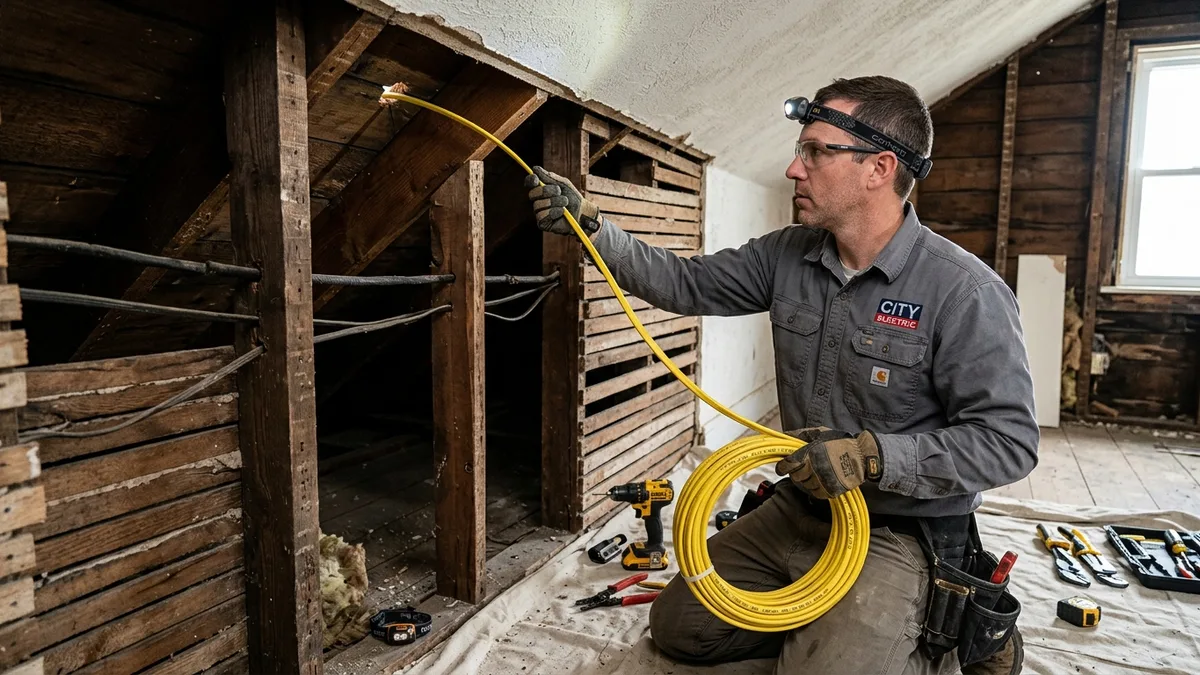
Specialized Whole-Home Rewiring and Historic Preservation in Independence, Missouri
Independence, Missouri is celebrated for its deep historical heritage and magnificent collection of architectural landmarks. From Queen Anne Victorians and American Foursquares in the Truman Heritage District to charming Craftsman bungalows and mid-century residences in the Englewood Arts District, these historic properties showcase remarkable woodwork, high ceilings, and sturdy plaster construction. However, concealed behind those historic lath-and-plaster walls sits an electrical distribution network that was frequently installed between 1890 and 1950—an era when electrical consumption was limited to a few incandescent light bulbs and a tabletop radio.
Today, operating modern lifestyle appliances—such as multi-ton air conditioners, microwaves, computers, and home entertainment systems—on century-old electrical wiring introduces severe life-safety and fire hazards. At Electrician Independence, our specialized electrical services network delivers surgical, comprehensive house rewiring services designed to modernize your home’s electrical safety while treating its historic architecture with the utmost care.
Every whole-home rewiring project is executed by experienced technicians who specialize in minimally invasive wire-fishing techniques that leave vintage plaster, custom crown molding, and hardwood baseboards virtually undisturbed. We pull all required trade permits through the City of Independence Building Inspection Division at 111 East Maple Avenue and coordinate closely with Independence Power and Light (IPL) when a service upgrade or meter relocation is required alongside interior rewiring.
Technical Dangers of Legacy Wiring: Knob-and-Tube and Cloth-Jacketed NM Cable
Many older homes throughout Independence still rely on obsolete branch wiring methods that fail to satisfy modern safety standards. Understanding the physical mechanics of these systems reveals why complete replacement is necessary:
1. Knob-and-Tube (K&T) Wiring (Circa 1880 to 1940)
Knob-and-tube was the earliest standardized residential wiring method. It utilizes single copper conductors suspended along structural joists and studs using porcelain insulating knobs, and routed through structural framing via cylindrical porcelain tubes:
- Absence of Equipment Grounding Conductors: Knob-and-tube systems utilize only two wires: an ungrounded hot conductor and a neutral conductor. They lack an equipment grounding conductor entirely. Modern appliances with three-prong plugs cannot safely dissipate leakage current, creating severe shock hazards.
- Deteriorating Varnished-Cloth Insulation: Conductor insulation consists of cotton fabric saturated in asphalt or varnish over rubber. After decades of thermal exposure and ambient humidity, the rubber dries out and turns brittle, flaking away to leave bare, energized copper conductors exposed inside wall cavities.
- Severe Fire Hazard When Insulated: Knob-and-tube conductors rely on open air circulation along floor joists and wall studs to dissipate heat generated by electrical current. When modern thermal insulation (such as blown-in fiberglass, cellulose, or spray foam) is installed over knob-and-tube wiring, heat cannot escape. Conductor temperatures rise rapidly, creating an immediate fire hazard. Consequently, National Electrical Code (NEC Article 394.12) explicitly prohibits thermal insulation from contacting active knob-and-tube wiring.
- In-Line Splicing Degradation: Early electricians spliced wires by twisting conductors together and wrapping them in friction tape without junction boxes. Over time, these uncontained splices oxidize, loosen, and produce dangerous electrical arcing.
2. Early Cloth-Jacketed Non-Metallic (NM) Cable (1940s to 1960s)
Introduced as an improvement over knob-and-tube, early non-metallic cable enclosed hot and neutral conductors inside an outer woven-cloth jacket:
- Ungrounded Two-Wire Construction: Cables manufactured prior to the mid-1960s did not include an equipment grounding conductor.
- Brittle Rubber Conductor Insulation: Like knob-and-tube, the individual wire insulation inside the cloth sheath utilizes rubber that dries out, cracks, and flakes off when disturbed during fixture replacements.
- Narrow Gauge and Missing Overcurrent Coordination: These circuits were frequently over-fused by early homeowners who replaced 15-amp fuses with 20-amp or 30-amp fuses, permanently annealing the copper wire and degrading insulation.
Insurance Company Underwriting and Home Sale Complications
In recent years, national homeowner insurance carriers operating in Missouri have dramatically tightened their underwriting guidelines regarding vintage electrical wiring. When purchasing a historic property or renewing a policy in Independence, insurance underwriters routinely require a 4-point electrical inspection.
If active knob-and-tube wiring, ungrounded cloth-jacketed wiring, or obsolete 60-amp fuse boxes are discovered during the inspection, underwriters frequently take immediate adverse action:
- Refusal to Issue Coverage: Carriers decline to bind insurance coverage until the knob-and-tube wiring is completely removed and certified by a municipal building inspection sign-off.
- Exclusion of Fire Losses: Some high-risk carriers agree to write policies only with explicit policy endorsements excluding all property damage caused by electrical fires.
- Demanding Massive Premium Surcharges: Policies that tolerate active knob-and-tube carry annual insurance premiums two to three times higher than properties with modern copper wiring.
Our network provides comprehensive certification letters and official City of Independence permit sign-offs that verify 100% knob-and-tube abatement, providing prospective homebuyers and current property owners with the documentation needed to secure preferred insurance underwriting rates.
Technical Standards Comparison: Legacy Wiring vs. Modern NM-B Cable
The comparison matrix below outlines the critical structural and safety differences between historic wiring systems and modern non-metallic sheathed cable:
| Structural / Code Metric | Vintage Knob-and-Tube Wiring | 1950s Cloth-Jacketed NM Cable | Modern Romex NM-B Copper Cable |
|---|---|---|---|
| Equipment Grounding Conductor | Completely absent (2-wire only) | Completely absent in most pre-1965 | Dedicated bare copper equipment ground |
| Conductor Insulation Temperature Rating | 60°C (140°F) maximum | 60°C (140°F) maximum | 90°C (194°F) high-temperature thermoplastic |
| Conductor Insulation Material | Rubber and asphalt-saturated cotton | Rubber and braided rayon/cloth | Polyvinyl Chloride (PVC) and Nylon jacketing |
| Permitted Contact With Thermal Insulation | Strictly prohibited by NEC 394.12 | Limited (Vulnerable to overheating) | Fully compliant with thermal attic insulation |
| Arc-Fault (AFCI) Breaker Compatibility | Incompatible (Causes nuisance trips) | Incompatible or highly problematic | 100% compatible with modern AFCI/GFCI |
| Modern Kitchen / Bath Appliance Support | Hazardous overload risk | Severe overload risk | Full capacity for dedicated high-draw loads |
| Insurance Underwriting Feasibility | Widely denied or non-renewed | Frequently flagged during sale | 100% approved by all national insurers |
Surgical Rewiring Techniques: Preserving Historic Lath and Plaster
The single greatest concern for historic homeowners contemplating a whole-home rewiring project is the potential destruction of original lath-and-plaster walls, decorative wood molding, and historic wall finishes. Informal electrical handymen frequently cut continuous trenches across walls, causing extensive, costly plaster repairs.
At Electrician Independence, our specialized technicians utilize surgical, minimally invasive wire-fishing techniques honed over decades of working in Jackson County historic homes:
1. Strategic Access Points
Rather than cutting into visible wall faces, technicians access wall cavities from unfinished attics, crawlspaces, unfinished basements, and behind removable baseboards.
2. Flexible High-Carbon Steel Fishing Rods
Technicians deploy long, flexible spring-steel drill bits and fiberglass wire-running rods to drill small passage holes through interior framing plates from above or below, pulling modern NM-B cables through hollow stud cavities without touching plaster surfaces.
3. Surgical Outlet Box Openings
Existing vintage metal device boxes are carefully removed from the plaster without cracking surrounding lath keys. New, code-approved thermoplastic or metal remodel boxes are installed directly into the existing opening, utilizing mechanical plaster clamps to lock securely into place.
4. Zero Open Trenching
We guarantee that our wire-fishing methodology avoids broad horizontal drywall trenching. In the rare event that an exploratory access hole is required to navigate a fire-block framing member, the hole is neatly cored and the plaster plug is preserved for simple patch restoration.
Upgrading to Modern Branch Circuit Architecture
Rewiring your home is not merely a replacement of conductors; it is an opportunity to modernize your electrical distribution layout to accommodate 21st-century lifestyles:
- Dedicated High-Draw Kitchen Circuits: Supplying minimum two dedicated 20-amp small-appliance branch circuits for kitchen countertops, plus dedicated individual circuits for the microwave, dishwasher, garbage disposal, and refrigerator per NEC 210.52(B).
- Dedicated Bathroom Receptacle Circuits: Installing dedicated 20-amp GFCI-protected circuits for modern high-wattage hair dryers and grooming appliances.
- Dedicated Garage and Workshop Power: Providing high-capacity circuits for power tools, air compressors, or future EV charger installations.
- Whole-Home Arc-Fault (AFCI) Circuit Protection: Modernizing your main panel with Dual-Function AFCI/GFCI breakers that instantly detect dangerous micro-arcing inside wall cavities before electrical fires can initiate.
- Seamless Integration With Panel Modernizations: Pairing your whole-home rewiring with an electrical panel upgrade in Independence MO to 200 amps ensures total system capacity and code compliance.
The Four-Phase House Rewiring Workflow
Executing a whole-home rewiring project requires thorough project management to minimize disruption to your household:
Phase 1: Comprehensive Architectural Audit and Load Design
Our lead electrician walks your property, maps existing branch circuits, assesses attic and basement access, identifies knob-and-tube runs, and calculates new circuit requirements. You receive an itemized written estimate detailing scope, room-by-room circuit additions, and municipal permit fees. To explore typical pricing ranges, review our electrician cost guide in Independence MO.
Phase 2: Permitting and Utility Coordination
Our office submits comprehensive single-line diagrams to the City of Independence Building Inspection Division (111 E. Maple Ave, phone: 816-325-7405). If your service entrance requires modernization, we coordinate planned meter disconnects directly with Independence Power and Light (IPL).
Phase 3: Phased Surgical Execution
Technicians work room by room, protecting floors with heavy canvas drop cloths and wearing sanitized shoe covers. New copper branch circuits are fished through wall cavities, home runs are routed back to the main electrical panel, and modern tamper-resistant outlets and switches are installed. Power is restored to completed circuits at the end of each working day, ensuring your home remains fully livable throughout the project.
Phase 4: Final Testing, City Sign-Off, and Clean-Tech Handover
Technicians perform comprehensive continuity, polarity, and load-balance verification. The City of Independence electrical inspector visits to inspect grounding and AFCI breaker operation, providing official permit closure documentation. All work areas are thoroughly vacuumed with HEPA equipment, leaving your home immaculate.
Schedule Your Historic Home Rewiring Consultation Today
Protect your family, preserve your historic architecture, and ensure uncompromised property insurance coverage with professional house rewiring from Electrician Independence.
Contact our local dispatch desk today at (816) 586-5537 to schedule an on-site rewiring assessment, or submit your property details through our secure online contact form. Our experienced historic preservation technicians will evaluate your wiring, outline your modernization options, and provide a clear written estimate for your review.
Transparent Pricing and Diagnostic Disclosure
Project costs, diagnostic fees, and installation rates displayed or discussed are regional market estimates for Independence, MO and surrounding Jackson County jurisdictions. Actual pricing varies based on exact on-site conditions, code compliance requirements, electrical panel capacity, materials needed, and municipal permit parameters enforced by the City of Independence Building Inspection Division or Independence Power and Light (IPL).
Estimates are for budgeting purposes only. Actual prices vary based on on-site conditions. Every service inquiry receives an on-site physical evaluation and a clear written estimate before any physical work begins.