Need Immediate Electrical Assistance in Independence?
Our experienced technicians are dispatched across Independence and surrounding Jackson County neighborhoods. Speak directly with our local dispatch desk for prompt troubleshooting coordination, safety inspections, and clear project estimates.
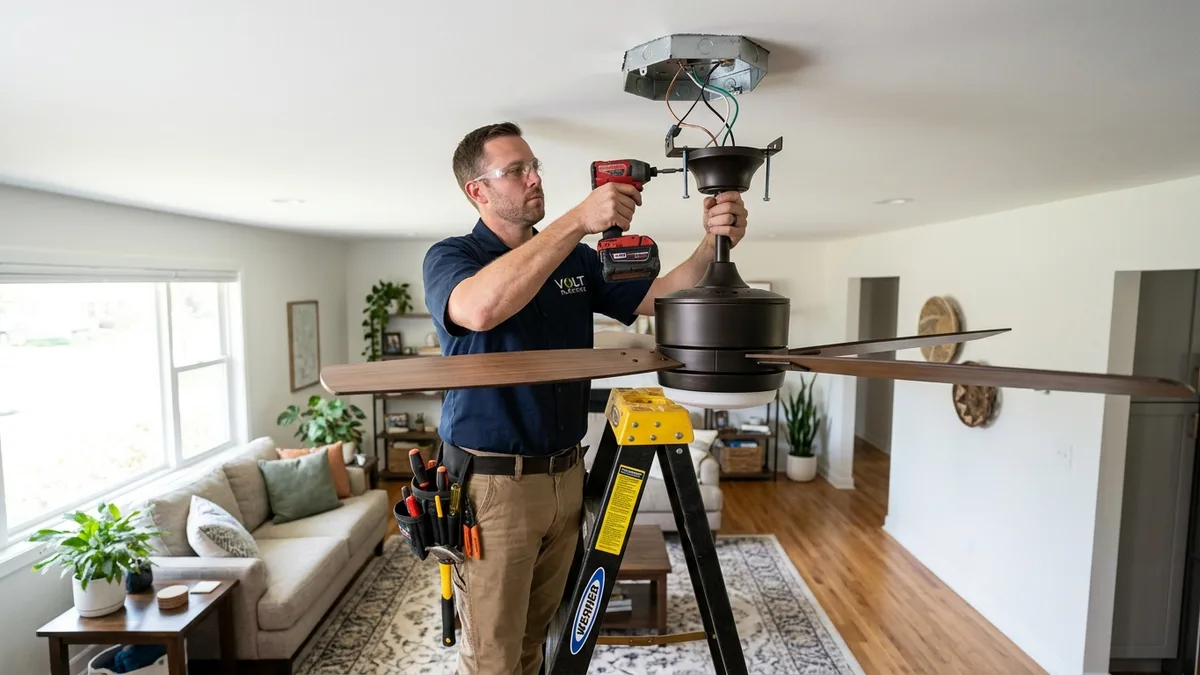
Precision Ceiling Fan Installation and Electrical Box Upgrades in Independence, Missouri
During the hot, humid summer months and variable transitional seasons in Independence, Missouri, a properly installed ceiling fan provides essential supplemental airflow and comfort. By producing an evaporative cooling wind-chill effect, a quality ceiling fan makes a room feel four to seven degrees cooler, allowing homeowners to raise their central air conditioning thermostats and reduce monthly electrical utility bills from Independence Power and Light (IPL). In the winter, reversing the fan’s motor direction pushes warm air trapped near high ceilings back down into the living area, reducing heating costs.
However, installing a ceiling fan involves far more than simply hanging a decorative fixture from an existing ceiling wire. Ceiling fans create continuous rotational kinetic torque, dynamic vibration, and significant physical weight (often ranging from 25 to 50+ pounds). Hanging a heavy, vibrating motor from a standard lightweight plastic or metal light fixture box represents a severe life-safety hazard that frequently results in wobbling, noisy motor operation, or catastrophic ceiling box tear-out.
At Electrician Independence, our specialized electrical services network delivers professional, code-compliant ceiling fan installation and replacement services throughout Independence, Blue Springs, Lee’s Summit, and Raytown. Our experienced technicians verify structural joist integrity, install heavy-duty UL-listed fan-rated ceiling boxes, pull new multi-conductor branch circuits for independent wall control, and precision-balance fan blades for silent, whisper-quiet operation.
National Electrical Code Mandates for Ceiling Fans (NEC Article 314.27©)
The National Electrical Code contains strict, specific safety requirements governing the structural support of ceiling-suspended paddle fans. Understanding these mandates ensures that your installation complies with local building safety ordinances enforced by the City of Independence Building Inspection Division:
1. Mandatory UL-Listed Fan-Rated Ceiling Boxes
Under NEC Article 314.27©, ceiling fans must never be supported by a standard outlet box designed solely for lightweight light fixtures. Standard fixture boxes utilize small #8-32 machine screws threaded into thin stamped metal or plastic tabs that easily shear under dynamic rotational vibration. Fan-rated boxes are stamped with an official UL listing certifying them to support dynamic fan loads of at least 35 to 70 pounds, utilizing heavy-gauge steel construction and heavy #10-24 or 1/4-inch hardened steel mounting bolts.
2. Retrofit Expanding Cross-Brace Brackets
When replacing a light fixture with a ceiling fan in a room with a finished ceiling and no attic access above, installing a traditional wood framing block is impossible without cutting out large sections of drywall or historic plaster. Our technicians deploy heavy-duty expandable steel cross-brace assemblies. Inserted through a standard four-inch ceiling opening, the threaded steel bar expands horizontally between two ceiling joists. Hardened steel prongs bite into the wood framing as the central shaft is tightened, creating an unbreakable structural anchor rated for fans up to 70 pounds without cutting into surrounding ceiling finishes.
3. Separation of Fan and Light Controls (14/3 or 12/3 Wiring)
Vintage homes often contain only a two-wire circuit (one hot and one neutral) running to the ceiling box, requiring homeowners to pull pull-chains to toggle the light and adjust fan speed. Our technicians can fish new three-conductor cables (14/3 or 12/3 NM-B) containing an additional red traveler conductor from the wall switch to the ceiling box, allowing independent wall switch control over the light fixture and the fan motor. Explore our outlet and switch installation services for advanced fan wall controls.
Technical Comparison: Indoor vs. Outdoor Ceiling Fan Ratings
Ceiling fans installed in covered outdoor patios, screened porches, or high-humidity bathrooms must feature appropriate UL wet or damp ratings to prevent motor corrosion and electrical shorts:
| Fan Rating / Environment | Environmental Resistance Level | Approved Installation Locations | Motor and Blade Metallurgy | Electrical Safety Benefit |
|---|---|---|---|---|
| UL Dry-Rated Fan | Zero moisture resistance (Indoor only) | Bedrooms, living rooms, dining rooms | Standard stamped steel and wood veneers | Basic indoor comfort |
| UL Damp-Rated Fan | Resists ambient humidity and condensation | Screened-in porches, covered patios, master baths | Moisture-sealed motor and ABS synthetic blades | Prevents humidity-induced motor shorts |
| UL Wet-Rated Fan | Direct exposure to water spray and rain | Open gazebos, pergolas, exposed decks | Completely sealed motor and UV-stabilized composite | Resists high-pressure hose washing |
Installing an indoor dry-rated fan on an outdoor Independence patio causes rapid motor coil corrosion, warped sagging blades, and internal short circuits that trip upstream breakers. Our technicians evaluate your installation environment and supply appropriate commercial-grade weather-sealed hardware.
High Ceilings and Downrod Sizing Specifications
To achieve optimal aerodynamic airflow, ceiling fan blades should be positioned between eight and nine feet above finished floor level. For homes with vaulted, cathedral, or two-story ceilings—common in newer subdivisions across Blue Springs and Lee’s Summit—installing the fan with a standard three-inch downrod traps air currents near the ceiling peak, rendering the fan ineffective.
Our technicians install rigid steel downrods sized specifically to match ceiling pitch and room volume:
| Finished Ceiling Height | Recommended Downrod Length | Distance of Blades Above Floor | Ideal Room Airflow Benefit |
|---|---|---|---|
| 8 Feet (Standard Ceiling) | Flush mount / Hugger or 3-inch rod | 7 feet to 7.5 feet | Optimal clearance in low rooms |
| 9 Feet | 6-inch downrod | 8 feet | Ideal residential airflow efficiency |
| 10 Feet | 12-inch downrod | 8 feet to 8.5 feet | Maximum downward air circulation |
| 11 to 12 Feet | 18-inch to 24-inch downrod | 8.5 feet to 9 feet | Eliminates dead-air ceiling pocket |
| 14 Feet (Vaulted) | 36-inch downrod | 9 feet | Reaches living occupancy zone |
| 16 to 18 Feet (Two-Story) | 48-inch to 72-inch downrod | 9 feet to 10 feet | Circulates massive air volume |
For sloped or vaulted ceilings exceeding 30 degrees of pitch, technicians install specialized angled-ceiling mounting canopies that allow downrods to hang perfectly plumb without binding against the ceiling canopy.
Precision Dynamic Balancing and Whisper-Quiet Operation
A wobbling, clicking ceiling fan is more than an annoyance; continuous mechanical vibration loosens ceiling box mounting screws and places fatigue stress on downrod hanger balls. Our technicians perform dynamic balance calibration on every fan installation:
- Digital Blade Leveling: Measuring the vertical distance from the tip of each blade to the ceiling surface with a precision gauge to confirm uniform blade tracking within one-sixteenth of an inch.
- Dynamic Weight Matching: Utilizing specialized balance clips and adhesive counterweights to compensate for microscopic weight variances in composite and hardwood fan blades.
- Electronic Motor Calibration: Verifying that electronic speed controllers and reverse-phase lighting dimmers do not introduce harmonic distortion that excites the motor’s stator laminations, guaranteeing silent, hum-free operation across all speed settings.
Smart Ceiling Fans, Remote Transmitters, and Wi-Fi Receivers
Modern ceiling fans increasingly feature integrated solid-state DC motors, handheld remote transmitters, and smart Wi-Fi receivers compatible with home automation systems:
- Ultra-Efficient DC Motors: Direct-current fan motors consume up to 70% less electricity than standard AC induction motors, provide six to eight granular speed settings, and operate with zero electrical hum.
- Canopy Remote Receiver Wiring: We wire compact solid-state radio-frequency receivers inside ceiling canopies, calibrating frequency DIP switches to avoid cross-signal interference with neighboring wireless equipment.
- Smart Home Integration: Configuring smart fan modules (Lutron, Bond, Hunter, Modern Forms) to sync with home automation routines, automatically adjusting fan speed based on room temperature sensors.
The Four-Phase Ceiling Fan Installation Workflow
When you schedule a ceiling fan installation through Electrician Independence, your project follows a disciplined craftsmanship protocol:
- On-Site Assessment and Written Estimate: Our technician inspects ceiling framing, verifies electrical box support ratings, evaluates existing wall switch wiring, and presents an itemized written estimate detailing all hardware, boxes, and labor. Review our transparent electrician cost guide in Independence MO for budgeting parameters.
- Clean-Tech Property Protection: Technicians slip on sanitized shoe covers and place heavy canvas drop cloths beneath the ceiling work zone to capture any dust or packaging debris.
- Structural Support and Electrical Rough-In: The old fixture is removed, an expandable steel fan-rated cross-brace box is secured to ceiling joists, and conductors are stripped, pigtailed, and torqued to code specifications.
- Assembly, Balance Calibration, and Clean-Tech Handover: The fan motor, downrod, canopy, blades, and light kit are assembled. Technicians perform dynamic balance testing, test remote controls, and vacuum the entire work area with HEPA equipment, leaving your room spotless.
Schedule Your Ceiling Fan Installation in Independence Today
Enjoy reliable summer cooling and winter heat circulation with professional, whisper-quiet ceiling fan installation from the experienced team at Electrician Independence.
Contact our local dispatch desk today at (816) 586-5537 to schedule an on-site installation, or submit your project details through our secure online contact portal. Our technicians will evaluate your ceiling structure, explain your control options, and provide a clear written estimate for your review.
Transparent Pricing and Diagnostic Disclosure
Project costs, diagnostic fees, and installation rates displayed or discussed are regional market estimates for Independence, MO and surrounding Jackson County jurisdictions. Actual pricing varies based on exact on-site conditions, code compliance requirements, electrical panel capacity, materials needed, and municipal permit parameters enforced by the City of Independence Building Inspection Division or Independence Power and Light (IPL).
Estimates are for budgeting purposes only. Actual prices vary based on on-site conditions. Every service inquiry receives an on-site physical evaluation and a clear written estimate before any physical work begins.