Need Immediate Electrical Assistance in Independence?
Our experienced technicians are dispatched across Independence and surrounding Jackson County neighborhoods. Speak directly with our local dispatch desk for prompt troubleshooting coordination, safety inspections, and clear project estimates.
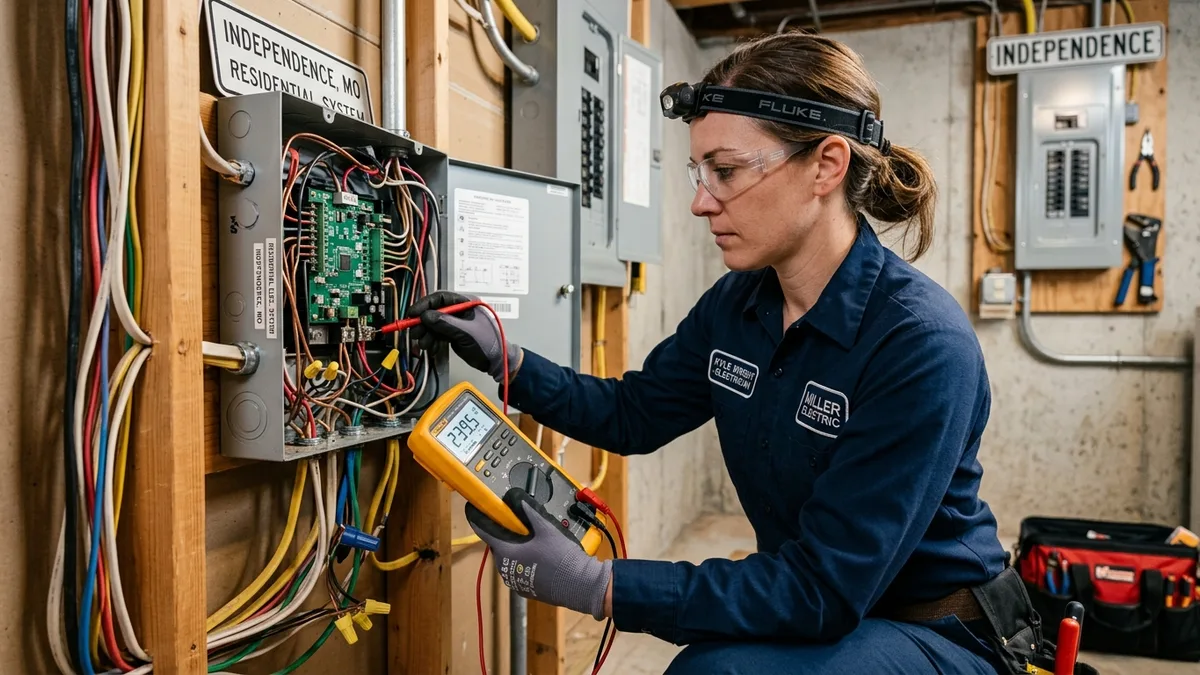
Empirical Electrical Troubleshooting and Diagnostic Engineering in Independence, Missouri
When electrical failures manifest within a residential home or commercial building, attempting to diagnose the underlying fault through guesswork or trial-and-error component replacement introduces severe hazards. Electrical distribution systems operate under tremendous kinetic potential; a loose connection, compromised conductor insulation, or overloaded neutral bus can generate extreme localized heat exceeding 1,000 degrees Fahrenheit in milliseconds. At Electrician Independence, our specialized electrical services network provides systematic, scientific diagnostic troubleshooting designed to isolate faults quickly, safely, and permanently.
Operating throughout Independence, Blue Springs, Lee’s Summit, and Raytown, our experienced technicians arrive on-site with advanced diagnostic test instruments. Rather than guessing which breaker or outlet might be causing a system malfunction, technicians measure actual voltage drops, harmonic distortion, current draw, and conductor insulation resistance. Whether your property is suffering from an unexplained circuit breaker that keeps tripping, widespread flickering lights in the house, or a sudden buzzing electrical panel, our field dispatch team delivers prompt emergency response backed by transparent written estimates.
Common Electrical Symptoms Demanding Professional Diagnostic Investigation
Electrical anomalies rarely resolve themselves; they typically escalate from minor operational annoyances into hazardous conditions. Review the common failure modes below:
1. Intermittent or Persistent Circuit Breaker Tripping
A thermal-magnetic circuit breaker contains two distinct tripping mechanisms: a bimetallic strip that deflects under sustained thermal overload, and an electromagnetic coil that trips instantaneously during a high-amperage dead short circuit. When a breaker trips repeatedly, identifying whether the failure stems from excessive appliance load, a failing appliance compressor, damaged in-wall wiring, or internal breaker fatigue requires specialized clamp-meter current measurement.
2. Dead Receptacle Outlets and Switched Leg Failures
When an entire room or a string of wall outlets suddenly loses electrical power while the breaker remains in the operational position, the failure typically originates at a back-stabbed push-in wire connection, a tripped hidden GFCI receptacle upstream, or an open neutral splice inside a junction box. Our technicians trace circuit paths using digital signal tone generators and high-frequency circuit tracers without tearing into drywall unnecessarily. Review our diagnostic guide on dead outlets not working.
3. Partial Power Outage (Dropped Utility Phase)
If 240-volt appliances (such as central air conditioners, electric water heaters, and clothes dryers) fail to operate while half of your 120-volt lighting circuits work and the other half are completely dead, your home has likely lost one of its two 120-volt incoming hot legs. This failure can occur at the main panel circuit breaker or outside on the overhead service drop operated by Independence Power and Light (IPL). Technicians take line-to-line and line-to-neutral voltage measurements at the main service disconnect to confirm whether the failure is customer-side or utility-side.
4. Overheating Switches, Receptacles, and Wall Plates
Wall switches and outlet faceplates should remain near ambient room temperature under normal operation. If a dimmer switch feels uncomfortably hot to the touch or an outlet plate displays brown heat discoloration, electrical resistance has increased to dangerous levels. This condition demands immediate diagnostic attention to prevent an in-wall structure fire. Review our safety protocols on electrical burning smells in the house.
The Scientific Four-Phase Troubleshooting Protocol
Our technicians follow a disciplined, four-phase diagnostic protocol based on NFPA 70E electrical safety guidelines and Institute of Electrical and Electronics Engineers (IEEE) testing methodologies:
| Diagnostic Phase | Objective and Action | Test Instruments Deployed | Safety Precaution |
|---|---|---|---|
| Phase 1: Visual and Sensory Triage | Inspecting deadfront panel interior, terminal lugs, wire insulation, and smelling for ozone or burning polymers. | High-intensity LED inspection lamps | Non-contact voltage sensing |
| Phase 2: Power Quality Verification | Measuring line-to-line, line-to-neutral, and line-to-ground voltages under both static and dynamic appliance loads. | True-RMS digital multimeters | High-voltage arc-flash face shield |
| Phase 3: Current and Thermal Mapping | Measuring live current draw on individual branch conductors and scanning bus bars for micro-arcing hotspots. | True-RMS clamp meters and FLIR thermal cameras | Insulated composite hand tools |
| Phase 4: Conductor Integrity Testing | De-energizing the circuit to perform continuity tracing and high-voltage dielectric insulation resistance testing. | Calibrated megohmmeters (500V/1000V DC) | Lockout/tagout protocol |
Technical Diagnostic Equipment Deployed on Every Call
Accurate electrical troubleshooting requires sophisticated instruments capable of capturing transient events and micro-resistances:
True-RMS Digital Multimeters
Standard averaging multimeters produce inaccurate voltage calculations when modern non-linear loads (such as LED lighting drivers, computer power supplies, and variable-frequency heat pumps) distort the sinusoidal 60 Hz electrical waveform. Our technicians utilize True-RMS multimeters that calculate the actual root-mean-square heating value of distorted waveforms, ensuring precise assessments across line-to-line (240V nominal) and line-to-neutral (120V nominal) potentials.
High-Resolution Infrared Thermographic Cameras
Loose terminal screws, oxidised bus bar stabs, and fatigued breaker contacts generate localized thermal signatures before physical smoke or melting becomes visible. High-resolution infrared thermal cameras allow technicians to visualize temperature differentials across panel interiors non-destructively, identifying connections operating above manufacturer thermal thresholds.
Digital Insulation Resistance Testers (Megohmmeters)
When an Arc-Fault Circuit-Interrupter (AFCI) breaker trips intermittently and standard resistance meters show no continuity to ground, the fault often involves microscopic insulation degradation along Romex wiring inside an attic or crawlspace. Our technicians apply a calibrated 500-volt direct current test pulse to evaluate the dielectric strength of the insulation, isolating nail punctures, rodent gnawing, or moisture ingress with mathematical certainty.
Nuisance AFCI Breaker Tripping: Micro-Arcing vs. High-Frequency Appliance Noise
One of the most complex diagnostic challenges in modern homes involves Arc-Fault Circuit-Interrupter (AFCI) nuisance tripping. AFCI breakers contain internal microprocessors programmed to analyze current and voltage waveforms for the unique high-frequency electrical signatures of dangerous arcing—such as a frayed lamp cord or a nail pierced through an in-wall Romex cable.
However, certain consumer appliances (including variable-speed motorized vacuum cleaners, older treadmills, cheap electronic power supplies, and laser printers) naturally produce harmless electrical noise that can mimic an arc signature, causing the AFCI breaker to trip erroneously. Our diagnostic technicians perform systematic waveform isolation:
- Appliance Signature Isolation: Unplugging all connected devices and introducing appliances sequentially under monitored clamp-meter analysis.
- Parallel Arc Detection: Testing for high-energy parallel arcs between line and neutral conductors.
- Series Arc Isolation: Inspecting back-stabbed switches and loose wire nuts along the entire branch circuit run to find low-current series arcing across loose mechanical joints.
- Dedicated Circuit Optimization: If a specific appliance requires high continuous current with heavy startup harmonics, running a dedicated home run circuit resolves the issue permanently.
Ground Fault Loop Impedance and Soil Resistivity Testing in Jackson County
Grounding is your electrical distribution system’s primary safety return path during a short circuit. If an ungrounded hot conductor comes into contact with the metal chassis of an appliance or metal electrical box, the system relies on a low-impedance ground path to deliver sufficient fault current to trip the circuit breaker instantaneously. If the grounding path possesses high electrical resistance, the breaker will fail to trip, leaving the appliance chassis energized at lethal 120-volt line potential.
Jackson County soils feature heavy clay compositions that swell during humid, rainy spring months and contract with deep fissures during hot, dry Midwest summers. This seasonal moisture fluctuation causes significant variations in earth contact resistance around grounding electrodes. Our technicians perform ground fault loop impedance testing and verify:
- Dual Ground Rod Sizing and Spacing: Confirming two full eight-foot copper-clad ground rods driven into undisturbed earth spaced at least six feet apart per NEC 250.53(A)(3).
- Interior Metallic Water Piping Bonding: Clamping continuous 4 AWG copper bonding jumpers around water meters to maintain electrical bonding to municipal water mains.
- Supplemental Electrode Bonding: Connecting interior rebar foundations (Ufer grounds) when available in newer construction or room additions.
Diagnostic Scenarios Common to Independence and Jackson County
The unique architectural history and municipal utility infrastructure of Independence create distinct diagnostic patterns:
Shared Neutral Voltage Swings in Historic Homes
In older homes throughout the Truman Heritage District and Englewood Arts District, electricians frequently encounter multi-wire branch circuits (MWBCs) where two hot conductors share a single neutral conductor. If the shared neutral splice becomes loose inside a junction box, voltage across the two circuits becomes unbalanced: one leg may drop to 75 volts (causing appliances to stall) while the opposing leg spikes to 165 volts (destroying electronics and burning out light bulbs). Our technicians trace neutral continuity across junction boxes to re-establish balanced return paths.
Aluminum Wiring Termination Degradation
Subdivisions constructed in Independence during the late 1960s and early 1970s often feature branch-circuit aluminum wiring. Aluminum expands and contracts under electrical load at a significantly higher rate than copper, causing screw terminals on standard receptacles to loosen over time. Furthermore, exposed aluminum oxidizes into aluminum oxide—an electrical insulator that creates extreme resistance and localized heat. Our technicians perform thorough thermal evaluations and execute code-compliant COPALUM or AlumiConn remediation to eliminate fire risks.
Storm and Lightning Transient Faults
Midwest thunderstorm seasons frequently bring violent cloud-to-ground lightning strikes that enter household distribution systems through overhead service drops or underground communication cables. Lightning surges often degrade delicate semiconductor components inside modern AFCI breakers, GFCI receptacles, and smart appliances without immediately tripping the breaker. Following severe storms, our team conducts full-system surge audits and recommends panel-mounted whole-home surge protection to safeguard electronics.
Transparent Diagnostic Fees and Transitioning to Permanent Resolution
We believe in complete pricing transparency from the moment our service vehicle arrives. Diagnostic evaluations begin with a standardized service call fee that covers our technician’s travel, initial on-site physical evaluation, and systematic diagnostic testing. To explore typical rates for service calls and troubleshooting across Jackson County, review our transparent electrician cost guide.
Once the fault is isolated, our technician outlines your repair options and provides an itemized written estimate before any physical repairs begin. Common permanent resolutions include:
- Circuit Breaker Replacement: Swapping fatigued or defective breakers with genuine OEM components torqued to exact manufacturer specifications. Explore our circuit breaker repair service.
- Service Panel Modernization: When diagnostic testing reveals extensive bus bar corrosion, obsolete equipment brands (Federal Pacific or Zinsco), or severe service overload, upgrading to a 200A service center is the safest path forward. Explore our electrical panel upgrade in Independence MO.
- Dedicated Branch Circuit Installation: If diagnostic current monitoring confirms that a microwave, space heater, or garage power tool is overloading a shared general lighting circuit, we install a dedicated copper circuit directly from the panel.
- Whole-Home Rewiring: When extensive insulation breakdown or ungrounded knob-and-tube wiring is discovered throughout vintage walls, phased rewiring provides modern safety. Explore our house rewiring services.
Schedule Your Emergency Electrical Diagnostic Evaluation Today
Do not leave flickering lights, tripping breakers, or burning odors to chance. Electrical faults do not repair themselves, and ignoring warning signs risks severe property damage or electrical fire.
Contact Electrician Independence today at (816) 586-5537 to schedule an on-site diagnostic evaluation with an experienced field technician, or submit your project details through our secure online contact form. Our team will identify the root cause, provide a clear itemized written estimate, and restore safe, reliable power to your property.
Transparent Pricing and Diagnostic Disclosure
Project costs, diagnostic fees, and installation rates displayed or discussed are regional market estimates for Independence, MO and surrounding Jackson County jurisdictions. Actual pricing varies based on exact on-site conditions, code compliance requirements, electrical panel capacity, materials needed, and municipal permit parameters enforced by the City of Independence Building Inspection Division or Independence Power and Light (IPL).
Estimates are for budgeting purposes only. Actual prices vary based on on-site conditions. Every service inquiry receives an on-site physical evaluation and a clear written estimate before any physical work begins.