Need Immediate Electrical Assistance in Independence?
Our experienced technicians are dispatched across Independence and surrounding Jackson County neighborhoods. Speak directly with our local dispatch desk for prompt troubleshooting coordination, safety inspections, and clear project estimates.
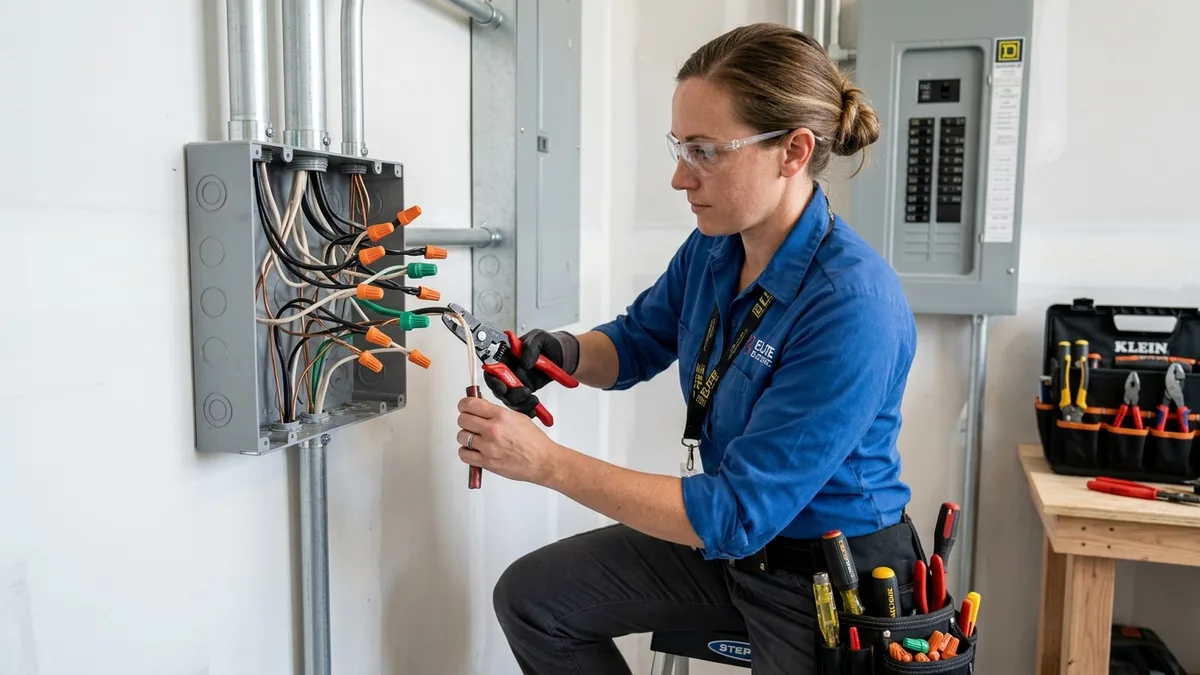
Professional Electrical Repair and System Restoration in Independence, Missouri
Electrical components within residential and commercial properties endure relentless thermal and mechanical stress. Every time an appliance turns on, current surges through copper conductors, generating localized heat that causes microscopic expansion and contraction across terminal lugs, wire nuts, and mechanical switch contacts. Over years of continuous operation, these thermal cycles cause mechanical screws to back out, spring-loaded receptacle contacts to lose tension, and wire insulation to degrade. At Electrician Independence, our specialized electrical services network delivers prompt, code-compliant electrical repairs designed to restore safety, efficiency, and functionality to your property.
Operating throughout Independence, Blue Springs, Lee’s Summit, and Raytown, our experienced technicians treat every electrical failure with the highest degree of technical care. Whether you are dealing with a dead wall outlet in your home office, a light switch that crackles when toggled, or an unexpected short circuit that plunged half your living room into darkness, our team arrives prepared to fix the root cause. We pull all necessary trade permits through the City of Independence Building Inspection Division at 111 East Maple Avenue and coordinate directly with Independence Power and Light (IPL) when meter bases or overhead service drops require repair.
Common Electrical Repairs Handled by Our Field Technicians
Electrical problems range from minor cosmetic annoyances to severe fire risks. Our technicians possess the testing equipment, parts inventory, and code knowledge to resolve a comprehensive spectrum of electrical repairs:
1. Receptacle Outlet Repair and Replacement
Wall receptacles naturally wear out after thousands of insertion cycles. When plug prongs feel loose or fall out of an outlet under their own weight, contact resistance increases dramatically, generating intense localized heat that can ignite wall studs. Technicians replace worn receptacles with commercial-grade, tamper-resistant devices and upgrade damp areas to code-compliant Ground-Fault Circuit-Interrupters (GFCI). Explore our dedicated outlet installation and repair service.
2. Light Switch and Dimmer Diagnostics
A wall switch should toggle smoothly without audible clicking, buzzing, or sparking. If a toggle switch crackles, feels warm to the touch, or fails to illuminate fixtures reliably, the internal mechanical contacts have pitted or oxidized. Our team diagnoses and replaces standard single-pole switches, three-way stairwell circuits, and modern solid-state LED dimmer controls.
3. Short Circuit and Ground Fault Abatement
When a short circuit occurs, an ungrounded hot conductor comes into direct contact with a neutral conductor or grounded metal box, unleashing an instantaneous surge of fault current that trips the breaker with a loud pop. Attempting to force a tripped breaker back into the on position can blow the breaker apart or cause in-wall wire fires. Our technicians utilize digital insulation resistance testers and signal generators to isolate hidden short circuits inside junction boxes, crawlspaces, and attics. Review our guide on circuit breakers that keep tripping.
4. Overheated and Discolored Junction Box Splices
Improperly twisted wire nuts, mismatched wire gauges, or unlisted wire splices concealed behind drywall frequently overheat. Over time, plastic wire nuts melt, scorching drywall and creating open neutral circuits. Our technicians excavate damaged splices, install code-compliant metal or thermoplastic junction boxes, and secure conductors using heavy-duty mechanical lever connectors or listed wire nuts.
5. Lighting Fixture and Ballast Modernization
Flickering fluorescent tubes, buzzing LED drivers, and overheating recessed can lights present frustrating lighting failures. Technicians diagnose power supplies, replace failing magnetic ballasts with energy-efficient electronic drivers, and retrofit vintage fixtures with modern architectural LED illumination. Explore our lighting installation services.
6. Main Breaker and Subpanel Terminal Maintenance
Loose neutral lugs or oxidized feeder conductors inside service panels cause widespread voltage fluctuations across your home. Technicians perform comprehensive torque audits using calibrated torque screwdrivers in compliance with NEC 110.14(D), tightening bus connections and replacing pitted circuit breakers. If panel damage is extensive, we provide turnkey electrical panel upgrades.
Aluminum Branch Circuit Remediation: The AlumiConn and COPALUM Methodologies
In various Independence residential subdivisions constructed between 1965 and 1974, home builders frequently installed solid aluminum branch-circuit wiring rather than copper due to copper commodity shortages. While aluminum is an effective electrical conductor, solid aluminum wire presents distinct physical characteristics that create fire hazards at mechanical connection points:
- Thermal Expansion Coefficient: Aluminum expands and contracts under electrical load at a rate nearly one-third higher than copper. Over years of thermal cycling, aluminum conductors work themselves loose from standard brass terminal screws on outlets and switches.
- Galvanic Corrosion and Oxidation: When exposed to atmospheric oxygen, aluminum forms an invisible surface layer of aluminum oxide. Unlike copper oxide (which remains moderately conductive), aluminum oxide is an electrical insulator. As oxide layers build across loose screw terminals, contact resistance surges, generating temperatures hot enough to ignite plastic receptacle boxes and surrounding wood framing.
- Creep and Cold Flow: Under continuous mechanical screw pressure, solid aluminum conductors gradually deform (or “creep”), reducing contact pressure and creating loose, arcing connections.
Our technicians execute code-compliant aluminum remediation using CPSC-approved (Consumer Product Safety Commission) methodologies. We install multi-port AlumiConn mechanical lug connectors pre-filled with antioxidant inhibitor compound, or deploy high-pressure COPALUM crimp compression connectors that cold-weld a solid copper pigtail to the existing aluminum conductor. This allows the pigtail to connect safely to modern standard receptacles and switches without fire hazard risks.
Multi-Wire Branch Circuit (MWBC) Shared Neutral Repair Protocols
Older homes throughout Jackson County often utilize multi-wire branch circuits (MWBCs), where two 120-volt hot conductors from opposite electrical panel phases share a single neutral conductor back to the panel. When functioning correctly, the neutral carries only the mathematical imbalance of current between the two hot legs.
However, if an untrained handyman breaks the neutral connection at a receptacle box or splices the shared neutral onto the wrong terminal, catastrophic failures occur:
- Open Neutral Overvoltage: If the neutral opens while appliances on both circuits are operating, the two 120-volt circuits are placed in series across 240 volts. High-resistance electronics (such as smart televisions, microwave computers, and refrigerator control boards) receive up to 180 volts, immediately burning out internal power supplies.
- Current Overload on Neutral: If both hot legs are accidentally connected to the same phase inside the breaker box, the neutral conductor carries the sum of both circuit currents (up to 30 to 40 amps), severely overheating the 14 AWG or 12 AWG neutral wire without either 15A or 20A single-pole breaker tripping.
Our repair technicians correct multi-wire branch circuits by:
- Installing two-pole handle-tied circuit breakers in the panel so that both hot conductors disconnect simultaneously during servicing per NEC 210.4(B).
- Verifying that hot legs originate from opposing panel bus phases (Phase A and Phase B).
- Pigtailing neutral conductors inside device boxes so that removing a receptacle does not interrupt the neutral continuity to downstream circuits per NEC 300.13(B).
Underground Service Lateral and Outdoor Direct-Burial Cable Repairs
Outdoor electrical circuits serving detached garages, pole barns, landscape lighting, and swimming pool pumps are subjected to aggressive environmental factors in Missouri:
- Frost Heave and Soil Movement: Deep winter freezes in Jackson County cause clay soils to expand and shift, placing severe tensile stress on direct-buried UF-B cables and rigid PVC conduit joints.
- Rodent and Pest Damage: Burrowing rodents frequently chew through thermoplastic insulation on direct-buried cables, creating intermittent ground faults that trip upstream GFCI breakers whenever the soil becomes wet.
- Moisture Ingress in Conduit Bodies: Temperature swings cause condensation to accumulate inside outdoor conduits, corroding wire splices and rusting metal junction boxes.
Our technicians locate underground cable faults using high-frequency radar cable fault locators and audio inductive receivers, pinpointing underground wire breaks without trenching entire yards. We execute permanent, watertight underground splices using heat-shrink tubing lined with heavy thermoplastic adhesive approved for direct-burial submersion.
Professional Electrical Repair vs. Informal DIY Handyman Fixes
Attempting to resolve electrical failures through informal handyman labor or unverified online tutorials introduces catastrophic life-safety hazards. The comparison matrix below outlines the critical differences between our professional dispatch network and unvetted repairs:
| Evaluation Standard | Electrician Independence Professional Network | DIY / Informal Handyman Fixes |
|---|---|---|
| Diagnostic Protocol | Empirical testing with True-RMS multimeters and thermal imaging | Visual guessing and trial-and-error part swapping |
| National Electrical Code Adherence | 100% compliance with current NEC and City of Independence amendments | Frequent code violations (over-fusing, improper wire gauge) |
| Splice Integrity Standards | Conductors pre-twisted and enclosed within accessible junction boxes | Hazardous flying splices buried inside wall cavities |
| Overcurrent Protection | Calibrated OEM breakers matched to conductor ampacity | Installing oversized breakers on undersized wire (fire hazard) |
| Property Protection Protocol | Mandatory sanitized shoe covers, heavy canvas drop cloths, vacuuming | Dirt tracked across floors, drywall plaster left behind |
| Pricing Transparency | Itemized written estimates with customer authorization prior to work | Escalating verbal estimates with hidden add-on costs |
| Municipal Permitting | Official permits coordinated through Independence City Hall | Bypasses permits, leaving property owners legally liable |
| Warranties and Accountability | Formal labor warranties and dedicated dispatch follow-up | Untraceable phone numbers when secondary failures occur |
The Four-Phase Electrical Repair Workflow
Every service call coordinated through our dispatch office follows an established quality assurance protocol designed for safety, speed, and total pricing clarity:
Phase 1: Intake and Diagnostic Dispatch
When you call our local office at (816) 586-5537, our service coordinator records your specific symptoms, property age, and urgency level. If you are experiencing hazardous conditions such as an electrical burning smell in the house or a buzzing electrical panel, we dispatch a nearby service vehicle with priority routing.
Phase 2: On-Site Evaluation and Written Proposal
Upon arrival, your technician puts on sanitized clean-tech shoe covers, inspects the affected circuits, and performs empirical electrical testing. Once the root cause is isolated, the technician provides an itemized written estimate outlining the required parts, labor, and permit fees. You maintain complete control over project authorization. To review typical service call costs, consult our electrician cost guide in Independence MO.
Phase 3: Precision Repair Execution
Using commercial-grade materials and insulated hand tools, technicians execute the approved repair. Every connection is torqued to manufacturer specifications, and all wire splices are housed within code-approved, accessible junction boxes. Heavy canvas drop cloths protect your floors and furniture throughout the repair process.
Phase 4: Operational Verification and Cleanup
Following physical repair, technicians perform operational load testing, polarity checks, and continuity verification. Work areas are thoroughly vacuumed with HEPA equipment, leaving your property immaculate.
Common Electrical Repair Challenges in Independence Neighborhoods
Independence features a rich variety of residential architecture, each with distinct repair requirements:
Historic Bungalows and Victorians (Truman Heritage District)
Homes throughout the Truman Heritage District frequently contain original or modified knob-and-tube wiring, ungrounded two-wire branch circuits, and brittle rubber-insulated wiring. Technicians specialize in surgical repairs that resolve short circuits while protecting delicate lath-and-plaster walls. When vintage wiring proves irreparable, we provide phased house rewiring services.
Commercial and Creative Studios (Englewood Arts District)
Galleries, pottery studios, and retail shops throughout the Englewood Arts District require dedicated high-amperage branch circuits to support heavy equipment without tripping general lighting breakers. Our commercial repair team resolves voltage drop issues, balances three-phase distribution panels, and installs dedicated circuits for kilns, compressors, and illuminated display cases.
Suburban Expansions (Blue Springs and Lee’s Summit Corridors)
In newer communities across Blue Springs and Lee’s Summit, repairs often center on outdoor GFCI receptacles, landscape lighting short circuits, hot tub subpanels, and Level 2 electric vehicle charging connections. Our technicians ensure that outdoor wiring utilizes weatherproof in-use covers and UV-resistant conduit.
Schedule Your Electrical Repair Service Today
Do not allow malfunctioning outlets, sparking switches, or tripping circuit breakers to compromise your family’s safety or interrupt your daily routine. Professional electrical repair is just a phone call away.
Contact Electrician Independence today at (816) 586-5537 to schedule an on-site evaluation, or submit your project details through our secure online contact portal. Our experienced professionals are ready to deliver the prompt, code-compliant, and transparent craftsmanship you deserve.
Transparent Pricing and Diagnostic Disclosure
Project costs, diagnostic fees, and installation rates displayed or discussed are regional market estimates for Independence, MO and surrounding Jackson County jurisdictions. Actual pricing varies based on exact on-site conditions, code compliance requirements, electrical panel capacity, materials needed, and municipal permit parameters enforced by the City of Independence Building Inspection Division or Independence Power and Light (IPL).
Estimates are for budgeting purposes only. Actual prices vary based on on-site conditions. Every service inquiry receives an on-site physical evaluation and a clear written estimate before any physical work begins.