Need Immediate Electrical Assistance in Independence?
Our experienced technicians are dispatched across Independence and surrounding Jackson County neighborhoods. Speak directly with our local dispatch desk for prompt troubleshooting coordination, safety inspections, and clear project estimates.
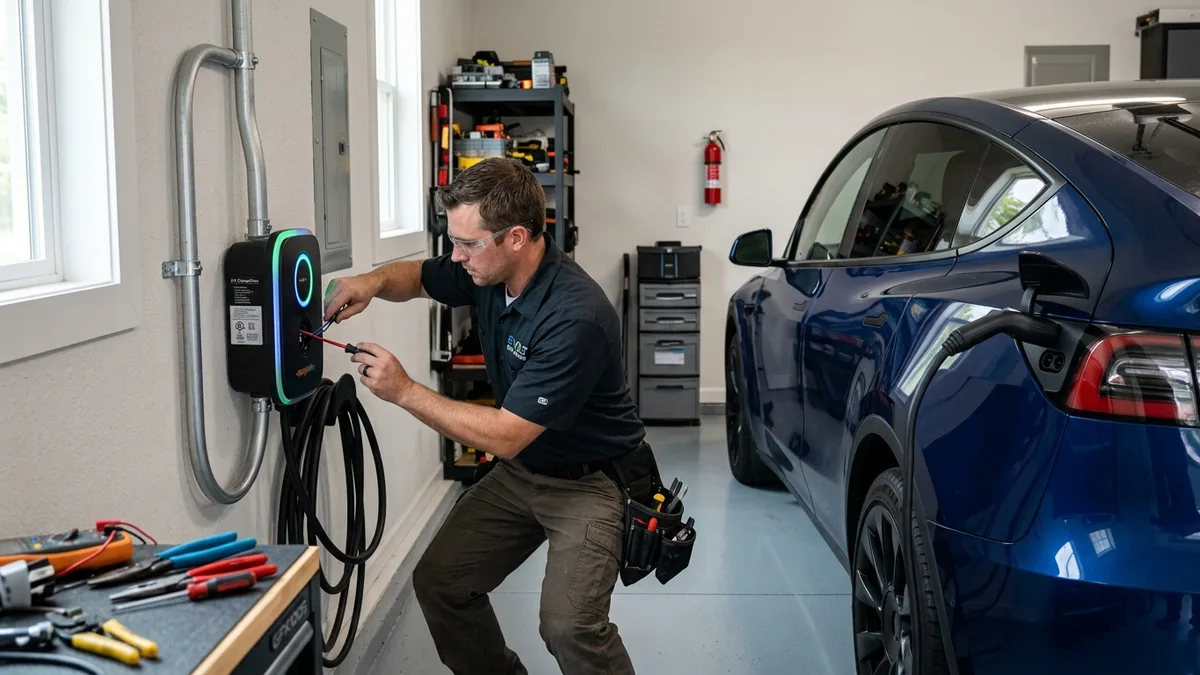
Dedicated Level 2 Electric Vehicle Charging Station Installations in Independence, Missouri
As automotive manufacturers transition toward all-electric and plug-in hybrid vehicle lineups, homeowners across Independence, Missouri are discovering the limitations of standard factory-supplied Level 1 charging cords. Plugging an electric vehicle into a standard 120-volt household receptacle delivers a mere 1.4 kilowatts of charging power, replenishing only three to five miles of driving range per hour. Fully replenishing an empty 75 kWh battery pack on a standard wall outlet requires upwards of 40 to 50 continuous hours—making daily commuting across the Kansas City metropolitan area difficult and inconvenient.
At Electrician Independence, our specialized electrical services network delivers turnkey Level 2 electric vehicle charging station installations designed for rapid, safe, and code-compliant home charging. Operating on dedicated 240-volt branch circuits delivering 7.6 kW to 11.5 kW of power, a professionally installed Level 2 charging station provides 25 to 45 miles of range per charging hour, fully charging your vehicle overnight while you sleep.
Every installation coordinated through our network is engineered to the highest safety standards: our technicians perform detailed electrical service load calculations under National Electrical Code (NEC) Article 220, pull all required trade permits through the City of Independence Building Inspection Division at 111 East Maple Avenue, install heavy-gauge copper conductors, and coordinate with Independence Power and Light (IPL) if an electrical panel upgrade in Independence MO is required to support the additional continuous load.
Technical Comparison: EV Charging Levels
Understanding the differences between Level 1, Level 2, and commercial DC Fast Charging clarifies why dedicated residential 240V charging is the industry standard for home installations:
| Metric / Parameter | Level 1 Trickle Charging | Level 2 Residential Station | DC Fast Charging (Commercial Only) |
|---|---|---|---|
| Operating Voltage | 120 Volts AC (Standard Outlet) | 208 to 240 Volts AC | 400 to 800 Volts DC |
| Amperage Range | 12 to 15 Amps | 32 to 50 Amps | 100 to 500+ Amps |
| Power Output | 1.4 kW to 1.9 kW | 7.6 kW to 11.5 kW | 50 kW to 350 kW |
| Range Added Per Hour | 3 to 5 miles | 25 to 45 miles | 150 to 300+ miles (in 20-30 min) |
| Full Charge Time (60-80 kWh) | 40 to 55 Hours | 6 to 9 Hours (Overnight) | 20 to 40 Minutes |
| Circuit Requirements | Standard 15A shared branch circuit | Dedicated 40A to 60A 240V circuit | Industrial utility 3-phase service |
| Home Feasibility | Universal (included with car) | Ideal for all garages / driveways | Not viable for residential properties |
National Electrical Code Mandates for Residential EV Charging (NEC Article 625)
Charging an electric vehicle is fundamentally different from operating standard household appliances. While appliances like dishwashers, microwaves, or clothes dryers operate cyclically or run for short durations, an EV charging station operates at maximum power continuously for six to ten consecutive hours. Under National Electrical Code Article 625, EV charging is classified as a continuous load, requiring strict adherence to specialized engineering rules:
1. The 125% Continuous Load Overcurrent Protection Rule
Under NEC 625.41 and Article 210.20, branch circuits supplying continuous loads must have an overcurrent protection device (circuit breaker) and conductor ampacity rated at not less than 125% of the continuous charging current. For example:
- A 32-amp charging station requires a minimum 40-amp circuit breaker (32A x 1.25 = 40A) and minimum 8 AWG copper wire.
- A 40-amp charging station requires a minimum 50-amp circuit breaker (40A x 1.25 = 50A) and minimum 6 AWG copper wire.
- A 48-amp charging station requires a minimum 60-amp circuit breaker (48A x 1.25 = 60A) and minimum 4 AWG copper wire.
Under-sizing the circuit breaker or conductor gauge results in dangerous conductor overheating, insulation degradation, and nuisance thermal tripping inside the electrical panel.
2. Hardwired Station vs. 240V NEMA 14-50 Plug-In Connection
Homeowners have two primary installation options for Level 2 charging equipment:
- Plug-In NEMA 14-50 Receptacle: Utilizes a heavy-duty, commercial-grade 240V receptacle in a garage or exterior wall. Plug-in units offer portability, allowing you to unplug the charger if you relocate. Under recent editions of the NEC, all 240-volt receptacles installed in residential garages or outdoors must be protected by a Ground-Fault Circuit-Interrupter (GFCI) circuit breaker in the panel.
- Hardwired Charging Station: Connects the dedicated heavy-gauge copper branch circuit directly into the charging station unit via rigid or liquidtight flexible metal conduit without a plug and receptacle interface. Hardwired installations support higher continuous charging rates (up to 48 or 50 amps on a 60-amp circuit), eliminate potential receptacle contact resistance heating, and frequently avoid nuisance GFCI tripping caused by dual-GFCI conflicts between the breaker and the charger’s internal ground-fault monitor.
Residential Electrical Load Calculation (NEC Article 220)
Before installing a high-amperage dedicated EV circuit, your existing electrical service panel must be evaluated to confirm that it possesses sufficient spare capacity to handle the added load. Many older homes throughout the Truman Heritage District and Englewood Arts District operate on 100-amp main service panels that are already near maximum capacity supporting central air conditioning, electric ranges, and clothes dryers.
Our technicians perform a formal NEC Article 220 residential load calculation considering:
- General Lighting and Receptacle Loads: Calculated at 3 volt-amps per square foot of living space.
- Small Appliance and Laundry Branch Circuits: 1,500 volt-amps per required circuit.
- Fixed Fastened-in-Place Appliances: Nameplate wattage of water heaters, dishwashers, disposal units, and microwave ovens.
- Heating and Air Conditioning Coincidence: Factoring the larger of either the central cooling system or electric heating system.
- Continuous EV Charging Load: Adding the 125% continuous EV load calculation (e.g., 11,520 volt-amps for a 48A / 60A circuit).
If the total calculated household load exceeds 80% of your panel’s rated capacity, installing an EV charger without a service modernization presents severe fire hazards and will fail municipal inspection. In these circumstances, our technicians outline a comprehensive electrical panel upgrade to 200 amps or install a smart energy management load-shedding device that temporarily pauses EV charging when central HVAC equipment cycles on.
Commercial Fleet Charging and Multi-Family Residential Solutions
Beyond private single-family garages, our network designs and installs commercial EV charging infrastructure for businesses, retail centers, apartment complexes, and municipal fleets across Jackson County:
Workplace and Retail Customer Charging
Installing dual-port Level 2 charging pedestals along commercial corridors—such as 39th Street, Noland Road, and the Hartman Heritage Center—attracts high-value customers and tenants. Commercial installations incorporate:
- Commercial 208V / 240V Three-Phase Distribution: Sizing distribution panels and subpanels to balance charging loads across phases without creating neutral overheating.
- Bollard and Impact Protection: Installing heavy-duty steel safety bollards filled with concrete to shield charging pedestals from vehicular collisions in parking lots.
- Smart Cloud Access and Billing Systems: Setting up networked charging stations with RFID card readers and mobile payment gateways for tenant billing.
Multi-Family and HOA Parking Infrastructure
Condominiums and multi-family communities face unique electrical metering challenges. Our commercial team designs sub-metered charging hubs, power-sharing smart panels that dynamically allocate available power across multiple vehicles, and underground conduit infrastructure engineered to accommodate future EV expansion.
Independence Power and Light (IPL) Grid Integration and Off-Peak Charging
Operating an electric vehicle in Independence provides distinct cost advantages due to competitive rates offered by municipal utility Independence Power and Light (IPL). However, drawing 32 to 48 continuous amps during peak evening hours (between 4:00 PM and 8:00 PM when residential air conditioning loads peak) places strain on local distribution transformers.
Our technicians configure smart Level 2 charging stations with programmable charging schedules:
- Automated Delayed Charging: Setting charging routines to initiate automatically at 11:00 PM or midnight during overnight off-peak hours when municipal grid demand and ambient garage temperatures are lowest.
- Transformer Capacity Verifications: For rural or older overhead distribution sectors where multiple neighbors install EV chargers on a shared pole transformer, our team coordinates with IPL Service Planning (816-325-7500) to ensure transformer ratings are adequate.
Step-by-Step EV Charger Installation Workflow
When you schedule an EV charger installation through Electrician Independence, your project follows a transparent four-phase execution plan:
Phase 1: On-Site Electrical Assessment and Written Estimate
Our technician inspects your electrical panel, measures available physical breaker spaces, calculates total household electrical demand, and determines the most efficient conduit pathway from the panel to your vehicle parking location. You receive an itemized written estimate detailing all copper conductors, conduit, breaker hardware, and municipal permit fees. To review pricing ranges, consult our transparent EV charger installation cost guide.
Phase 2: Municipal Trade Permitting
Our office submits trade permit applications and electrical schematics directly to the City of Independence Building Inspection Division (111 E Maple Ave, phone: 816-325-7405). Permitting guarantees that your installation satisfies local building codes, preserves your homeowner insurance coverage, and provides official documentation for local utility rebate programs.
Phase 3: Physical Installation and Conduit Run
On installation day, technicians wear clean-tech protective shoe covers and place heavy canvas drop cloths in all indoor work zones. We install:
- A new, factory-certified OEM two-pole circuit breaker in your electrical panel.
- High-temperature THHN copper conductors sized specifically for your charging unit.
- Durable electrical metallic tubing (EMT) conduit, rigid metal conduit (RMC), or liquidtight flexible metal conduit routed neatly along structural framing.
- A heavy-duty, commercial-grade NEMA 14-50 receptacle or direct hardwire connection into your chosen charging station (Tesla Wall Connector, ChargePoint Home Flex, JuiceBox, or Emporia).
Phase 4: Torque Verification, Commissioning, and City Inspection
Every mechanical termination screw is tightened using calibrated torque tools to manufacturer specifications in compliance with NEC 110.14(D). Technicians power on the unit, configure internal DIP switches for maximum allowable circuit amperage, verify Wi-Fi connectivity, and test charging communication with your vehicle. Finally, we coordinate the municipal final inspection sign-off through City Hall.
Protecting Your Investment With Surge Protection
Modern electric vehicles contain sophisticated battery management computers, onboard inverters, and sensitive solid-state charging modules that are highly vulnerable to transient voltage spikes caused by lightning storms across Jackson County. Installing a panel-mounted whole-home surge protection device alongside your EV charger defends both your home and your vehicle’s expensive onboard electronics against grid surges and lightning transients.
Schedule Your EV Charger Installation in Independence Today
Ready to enjoy the convenience of waking up every morning to a fully charged vehicle? Trust the experienced professionals at Electrician Independence to engineer a safe, rapid, and code-compliant home charging station.
Contact our local dispatch desk today at (816) 586-5537 to schedule an on-site evaluation, or submit your vehicle and property details through our secure online contact form. Our team will evaluate your panel capacity, outline your charging options, and provide a clear written estimate for your review.
Transparent Pricing and Diagnostic Disclosure
Project costs, diagnostic fees, and installation rates displayed or discussed are regional market estimates for Independence, MO and surrounding Jackson County jurisdictions. Actual pricing varies based on exact on-site conditions, code compliance requirements, electrical panel capacity, materials needed, and municipal permit parameters enforced by the City of Independence Building Inspection Division or Independence Power and Light (IPL).
Estimates are for budgeting purposes only. Actual prices vary based on on-site conditions. Every service inquiry receives an on-site physical evaluation and a clear written estimate before any physical work begins.